
Regenerative · For the Planet
The ancestors' way is regreening the desert
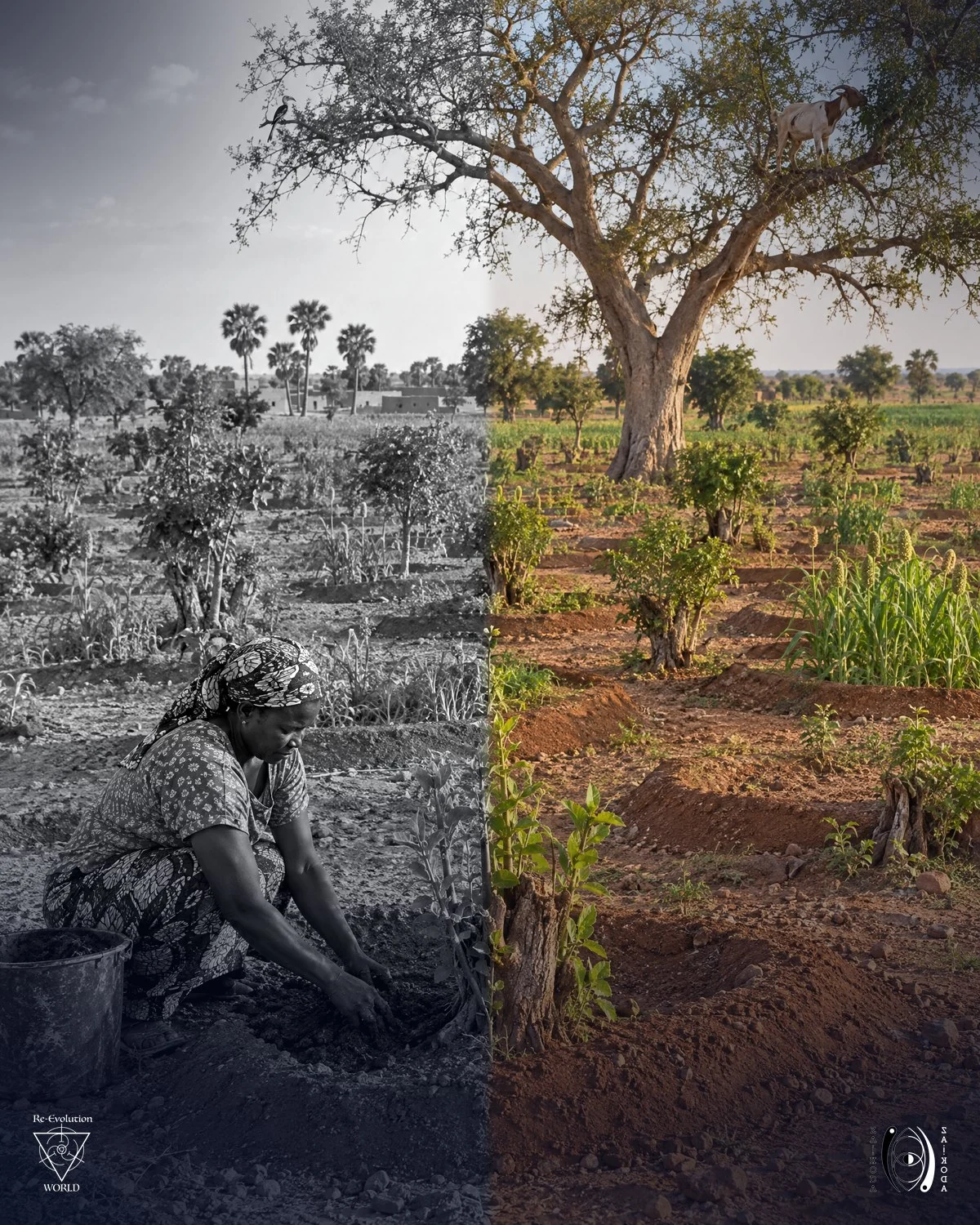
In Niger, farmers brought trees back to millions of hectares of bare farmland without planting a single seedling. The forest had been hiding underground all along, waiting for someone to remember how to let it grow.
5 minute read · Facts checked as of November 2026
Some revolutions arrive with drums and banners. This one arrived quietly, one tree stump at a time, in some of the hottest, hungriest farmland on Earth.
Forty years ago, the farming heartland of central Niger looked finished. By the mid-1980s almost all of its natural vegetation was gone, and the fields lay open to the wind1. Farmers often had to sow the same crop several times in a season, because sandstorms kept burying the seedlings1.
Today, across millions of hectares of that same farmland, there are trees again. Nobody planted them. Farmers simply let them grow.
The underground forest
One origin story begins in 1983 with Tony Rinaudo, an Australian agronomist who had spent years watching planted seedlings die in Maradi1. Then he noticed green shoots in a sandy field, rising from old tree stumps hidden just below the surface. Beneath the bare fields, he realised, lay an underground forest: living roots that had been cut back again and again and never allowed to grow1.
The practice that grew from this is called farmer managed natural regeneration. It is beautifully simple: choose the strongest stems sprouting from a stump, protect them, prune them, and let them become trees again. And it spread the way real knowledge spreads, farmer to farmer. When neighbours saw better harvests in fields with trees, many hundreds of thousands of farmers in the Maradi and Zinder regions took it up, most of them on their own initiative1.
Five million hectares
Between 2004 and 2009, researchers Adam Toudou, Abasse Tougiani and Chris Reij used satellite images and field visits to measure what had happened. Smallholder farmers in Zinder, Maradi and nearby parts of Tahoua had brought trees back to about five million hectares of farmland1. The researchers describe it as most likely the greatest positive environmental transformation in Africa, achieved in one of the poorest countries on Earth1. That figure comes from the studies of that time, so read it as what farmers had achieved by then, not a fresh count for today.
The trees changed everything around them. Crops sheltered from the wind needed sowing only once. Leaves and twigs became fodder, firewood and richer soil, so families could keep more livestock1. In 2011, a year of serious drought when Niger's national grain shortfall was estimated at around 500,000 tonnes, farmers in Kantché district, where trees are dense, produced a grain surplus of almost 14,000 tonnes1.
The forest was never gone. It was waiting underground for permission to grow.
The pits that catch the rain
Across the border in Burkina Faso, a farmer named Yacouba Sawadogo became known as the man who stopped the desert5. His tool was zaï: traditional planting pits dug into hard, degraded ground to hold soil, water and organic matter right where a seed needs them5. In 2018 he received the Right Livelihood Award, and the foundation credits his work training other farmers with restoring tens of thousands of hectares of severely degraded land to productivity in Burkina Faso and Niger5.
When a government follows the farmers
For a long time, the common view in Niger was that all trees belonged to the government, and even as that changed, farmers still needed a forestry permit to harvest the trees in their own fields1. On 30 July 2020, Niger's President signed a decree that recognises farmers' rights to the trees on their farms and lets them prune and thin them without fear of fines12. Niger was one of the first countries in the world to back this practice by presidential decree2.
Niger has also pledged to restore 3.2 million hectares under AFR100, an African initiative to restore 100 million hectares of land by 20303. The work goes on: in August 2025 the World Bank reported that a landscape project in the Tahoua region had restored about 18,000 hectares of degraded land, including assisted natural regeneration on 10,500 hectares, alongside half-moon water catchments and new income for rural youth and women's groups4.
Sustainability is sovereignty
Notice what made this work. Not aid convoys, not a plantation company, not a patent. Farmers who knew their land, a technique older than any of us, and, at last, the legal right to own the trees they tended. The moment people held the fruits of their own care, the desert began losing ground. That is sustainability as sovereignty, written in leaves.
Where this leads
Now picture the pattern everywhere. Every village with tired land holding the keys to its own recovery. Elders' knowledge and satellite eyes in the same conversation: AI reading the greening from orbit, farmers trading what works with the next valley over by voice note. Laws that reward the people who tend the trees. Not a string of one-off projects, but a living network of regenerating places, each one sovereign, all of them learning from each other. That is the Eco Startup Society we are here to seed: rooted in what the ancestors knew, amplified by what we can now build.
The Sahel still faces drought and hard years, and five million hectares was a measure taken a while ago. But the lesson holds. Sometimes regeneration is not about adding anything at all. It is about protecting what is already trying to come back.
So, Sentient: what in your own patch of the world is quietly trying to regrow, and what would it take to let it?
Deep gratitude to the farmers of Maradi and Zinder, and to the Ancient Ones who knew this first… 🙏🏽
You are the Seed, You are the Solution, You are the Sentient Re-Evolution… 🌱
Sources
- 1. Large-scale regreening in Niger: lessons for policy and practice (Toudou, Tougiani and Reij, ETFRN News 60), UNCCD. Back to top
- 2. Niger formally adopts farmer-managed natural regeneration, UNCCD, from World Agroforestry (ICRAF). Back to top
- 3. African Countries Launch AFR100 to Restore 100 Million Hectares of Land (December 2015), World Resources Institute. Back to top
- 4. Restoring land and livelihoods in Niger's Tahoua region (August 2025), World Bank, Sahel RESILAND. Back to top
- 5. The man who stopped the desert receives 2018 Right Livelihood Award, Right Livelihood. Back to top
Want stories like this in your inbox, alongside our gatherings? Subscribe for updates.
Keep reading

Universal · For the People
Robots are learning the hardest job on Earth: your home
The first humanoid robots built for the home can now be ordered. A home is one of the hardest places on Earth for a machine, and they are early, imperfect and still partly guided by humans. But a whole family of exponential technologies is converging to crack it, and the curve points somewhere extraordinary: the hours of your life, handed back.
6 minute read

Abundance · For Freedom
The first human trial to turn back the clock in our cells
For the first time, people have received a therapy designed to turn back the clock inside their own cells. Three patients, eight weeks, one eye each: a small step that opens a very large door. Here is what has actually happened, and what has not.
5 minute read