
Abundance · For Freedom
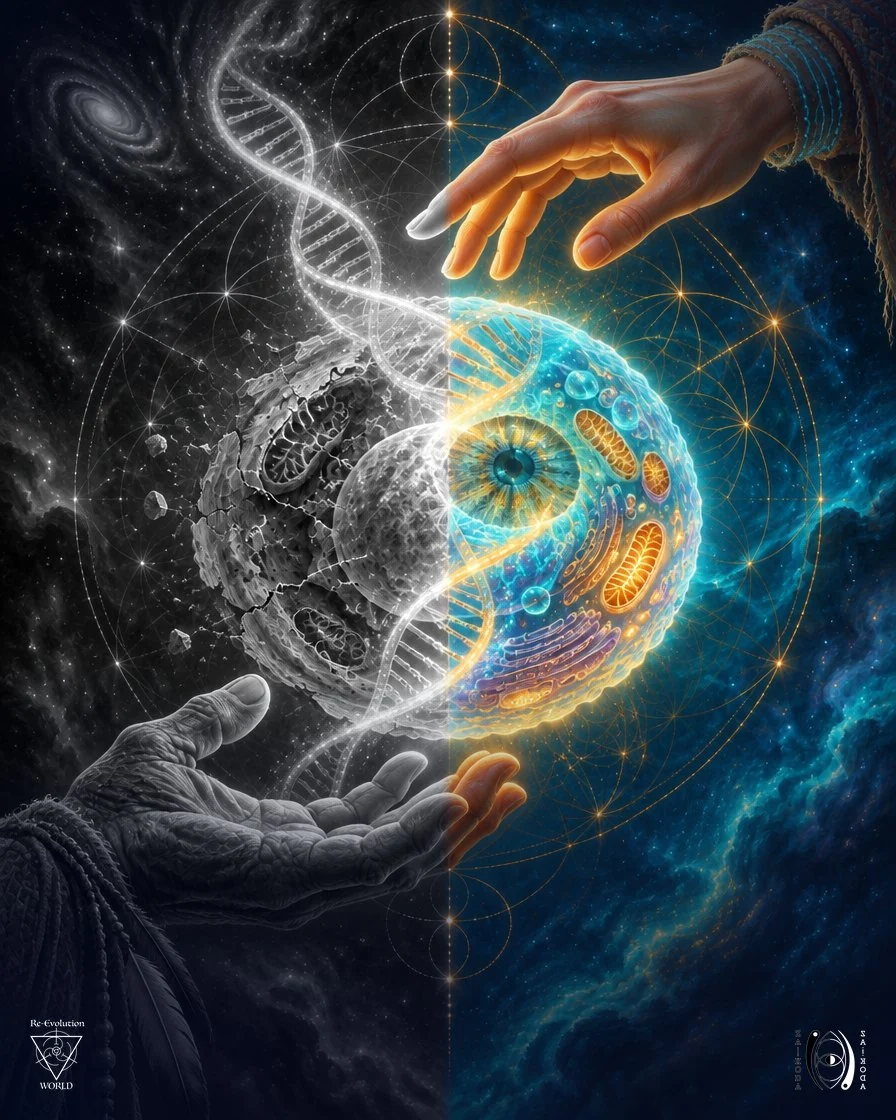
The first human trial to turn back the clock in our cells
For the first time, people have received a therapy designed to turn back the clock inside their own cells. Three patients, eight weeks, one eye each: a small step that opens a very large door. Here is what has actually happened, and what has not.
5 minute read · Facts checked as of November 2026
Every tradition has its elixir: the Taoist alchemists in their mountain laboratories, the fountain of youth, the soma of the Vedic hymns. For thousands of years the dream of renewal lived in myth. This year it entered a clinical trial, wearing a lab coat and carrying a consent form.
Every cell in your body carries the same DNA. What makes a cell young or old, healthy or tired, is partly how that DNA is read: a layer of chemical marks known as the epigenome. A growing body of research suggests that as we age, those marks drift, and cells lose the instructions that kept them youthful.
In 2012 the Nobel Prize in Physiology or Medicine was shared by Shinya Yamanaka, whose team found that a handful of genes could reset an adult cell all the way back to a stem cell1. The question that followed was bold: what if you could reset a cell only part of the way, restoring youthful function without erasing what the cell is?
From mice to the first human
In 2020, a team in David Sinclair's lab at Harvard reported in Nature that switching on three of those genes, known as OSK, in the eyes of mice restored vision in older animals and after nerve injury2. Life Biosciences, a company Sinclair co-founded, set out to bring that idea to people.
On 9 June 2026, Life Biosciences announced that the first person had been dosed with its therapy ER-100 in a Phase 1 trial for two causes of vision loss: open-angle glaucoma and a type of optic nerve stroke called NAION3. ER-100 delivers the three OSK genes in a controlled way, and the company describes it as the first clinical candidate from its Epigenetic Restoration platform3. It is widely reported as the first time a partial reprogramming therapy has been given to a human.
The first data
On 8 October 2026 the company shared its first human data4. Three people with glaucoma each received a single injection into the eye at the lowest dose, with a daily oral medicine, doxycycline, used to switch the genes on4. Through 56 days there were no serious adverse events and no dose-limiting side effects, and the reported side effects were put down to the procedure, the steroid used alongside it, or existing conditions4. An independent safety board recommended moving to a higher dose4.
In two of the three people, tests of the visual field showed improvement, which the company calls preliminary signals4.
Three people, eight weeks, no control group. A beginning, not a proof.
That needs to be held with care. This is an open-label safety trial in three people, with no comparison group, and it was not designed to prove the treatment works4. It treats the eye, not the whole body. Nobody has yet shown that ageing can be reversed in a human being. What has been shown is that the first people have received this kind of therapy and, so far, safely.
Where AI comes in
Artificial intelligence is starting to redesign the tools of rejuvenation themselves. In August 2025, OpenAI and Retro Biosciences reported that a specialised protein-design model, GPT-4b micro, had proposed new versions of two of the reprogramming proteins, SOX2 and KLF45. More than 30 per cent of the AI-designed SOX2 variants beat the natural protein in early lab screens, and nearly half of the KLF4 designs did, where typical hit rates are below 10 per cent5.
Their best combinations produced more than 50 times higher expression of stem cell markers than the natural versions in the lab, and in stressed human cells they were linked with lower signs of DNA damage5. To be precise: that 50-fold figure measures marker expression in dishes of cells, not a 50 times faster or better therapy, and none of this has been tested in people5. OpenAI also notes that Sam Altman is an investor in Retro Biosciences5.
Where this leads
Abundance, for us, starts with health, and health is the first sovereignty: the freedom to live fully in your own body, on your own terms. Imagine a future where the slow decline we call ageing is something medicine can repair, one tissue at a time: first the eye, then perhaps the joints, the skin, the heart. Clear sight at ninety. Strength and curiosity that last as long as our love of life does. The old practices people have trusted for millennia, breath, movement, heat, cold and stillness, working alongside new tools that repair what time wears down. (Your kung fu teacher will still expect you at training.)
So here is a question worth sitting with, Sentient: what would you do with a few extra decades of good health? Plant a forest and live to walk in its shade? Master a craft, raise a village, start the project you keep postponing? A longer healthy life is not just more time. It is more freedom to become who we came here to be.
Hope is not the same as proof, and we will keep telling the difference. But for the first time, the question is being asked inside a human trial, carefully and step by step. That is real, and that is good news.
You are the Seed, You are the Solution, You are the Sentient Re-Evolution… ♾️
Sources
- 1. The Nobel Prize in Physiology or Medicine 2012, press release, NobelPrize.org. Back to top
- 2. Reprogramming to recover youthful epigenetic information and restore vision (Lu et al., 2020), Nature. Back to top
- 3. Life Biosciences Announces First Patient Dosed in Phase 1 Trial of ER-100 for Optic Neuropathies, Life Biosciences. Back to top
- 4. Life Biosciences Announces First-in-Human Data from Ongoing Phase 1 Trial Evaluating ER-100 in Optic Neuropathies, Life Biosciences. Back to top
- 5. Accelerating life sciences research with Retro Biosciences, OpenAI. Back to top
Want stories like this in your inbox, alongside our gatherings? Subscribe for updates.
Keep reading
Regenerative · For the Planet
The ancestors' way is regreening the desert
In Niger, farmers brought trees back to millions of hectares of bare farmland without planting a single seedling. The forest had been hiding underground all along, waiting for someone to remember how to let it grow.
5 minute read
Universal · For the People
Robots are learning the hardest job on Earth: your home
The first humanoid robots built for the home can now be ordered. A home is one of the hardest places on Earth for a machine, and they are early, imperfect and still partly guided by humans. But a whole family of exponential technologies is converging to crack it, and the curve points somewhere extraordinary: the hours of your life, handed back.
6 minute read