
Universal · For the People
Robots are learning the hardest job on Earth: your home
The first humanoid robots built for the home can now be ordered. A home is one of the hardest places on Earth for a machine, and they are early, imperfect and still partly guided by humans. But a whole family of exponential technologies is converging to crack it, and the curve points somewhere extraordinary: the hours of your life, handed back.
6 minute read · Facts checked as of November 2026
The old stories are full of tireless helpers: the bronze giant Talos guarding Crete, the golem of clay, the enchanted broom that would not stop fetching water. We have dreamed of them for thousands of years. They are now taking pre-orders.
How much of your life goes to the washing, the dishes, the tidying, the endless reset of a home? In Australia, people spend on average about three and a half hours a day on unpaid work, which includes housework, caring and volunteering1. Across a week, that is more than a full working day, and then some.
Imagine getting a good part of that back. Time for your children, your craft, your health, your community, your practice. That is the real promise of the home humanoid robot. Not a gadget, but time freedom.
The hardest place on Earth for a robot
Robots have welded car bodies on assembly lines for decades. A factory is a robot's paradise: the same parts, in the same places, under the same lights, millions of times over. Your home is the opposite. Every floorplan is different. Socks migrate. Toddlers rearrange the furniture, the cat lies exactly where the robot wants to step, and somewhere an albino goat has wandered in from the garden. As MIT Technology Review put it, homes come with children, pets, wildly varying floorplans and all sorts of mess8.
Roboticists call the deeper puzzle Moravec's paradox: the things we find hard, like chess and calculus, come easily to machines, while the things a toddler does without thinking, seeing, grasping, balancing, adapting, are fiendishly difficult7. Folding a towel in a stranger's house turns out to be one of the great unsolved problems in engineering. Which makes what is happening now all the more remarkable.
Where things actually stand
The company furthest along in selling a humanoid to households is 1X, with a robot called NEO. Orders are open in the United States, to buy outright or by subscription, and 1X says US deliveries start in 20262. Its example tasks are simple and human: getting the door, doing the laundry2.
Here is the honest part. NEO arrives with what 1X calls basic autonomy, growing in capability over time2. For tasks it cannot yet do alone, 1X offers a scheduled Expert Mode, where a trained person at 1X remotely guides the robot2. As of October 2026, reporting noted there was still no independently verified case of a paying customer receiving a NEO at home, and that hands-on testers had seen it rely on a remote human operator for household tasks3. If you value privacy, that matters: a person, at agreed times, may be seeing your home through the robot's eyes. Read the terms closely before you invite one in.
The learning is speeding up
Figure, another US company, is building its third-generation humanoid, Figure 03. In April 2026 it said it had moved from making one robot a day to one an hour, and had delivered over 350 of them for research, data collection, housework development and commercial work4. It has not announced a price or a home release45.
In September 2026 Figure tested its newest robot brain in 30 real homes in the San Francisco Bay Area that it had never seen before, asking it to tidy living rooms, fold towels and make beds5. It fully completed the task in 56 per cent of attempts, compared with 9 per cent for a version trained without its large dataset of human movement5. Figure itself says this does not mean general robotics is solved5. But a robot walking into a stranger's home and making the bed more than half the time, with no prior practice in that home, is a real step.
The price is falling
At the other end of the market, the Chinese company Unitree lists its R1 humanoid from US$4,900, excluding tax and shipping6. It is not a housekeeper. Unitree describes it as a pioneer platform, says some functions are still in development, and advises buyers to understand the limits of humanoid robots before purchasing6. What it shows is how fast the cost of a walking, seeing, two-armed machine is coming down.
The convergence
Why now? Not because of one breakthrough, but because several exponential technologies are braiding together. AI models that can see, understand language and turn both into movement, the same family of technology behind today's chatbots, are becoming robot brains8. Robots are learning from each other: in 2023, Google DeepMind and partners pooled experience from 34 research labs and 22 kinds of robot, covering 527 skills, and a model trained on the shared data learned skills about 50 per cent more successfully than each lab's own systems8. Bodies are getting cheaper: an early home robot called PR2 cost around US$400,000, while research robots built from off-the-shelf parts now cost tens rather than hundreds of thousands8, and Unitree's starts under US$5,0006. And human guidance at a distance, the same kind 1X uses today, turns every guided chore into a lesson the robot can learn from82.
Each of these alone would be progress. Together they compound, and you can see it in the numbers above: one robot a day became one an hour, and a home success rate of 9 per cent became 5645. That is what exponential looks like from the inside.
Where this leads
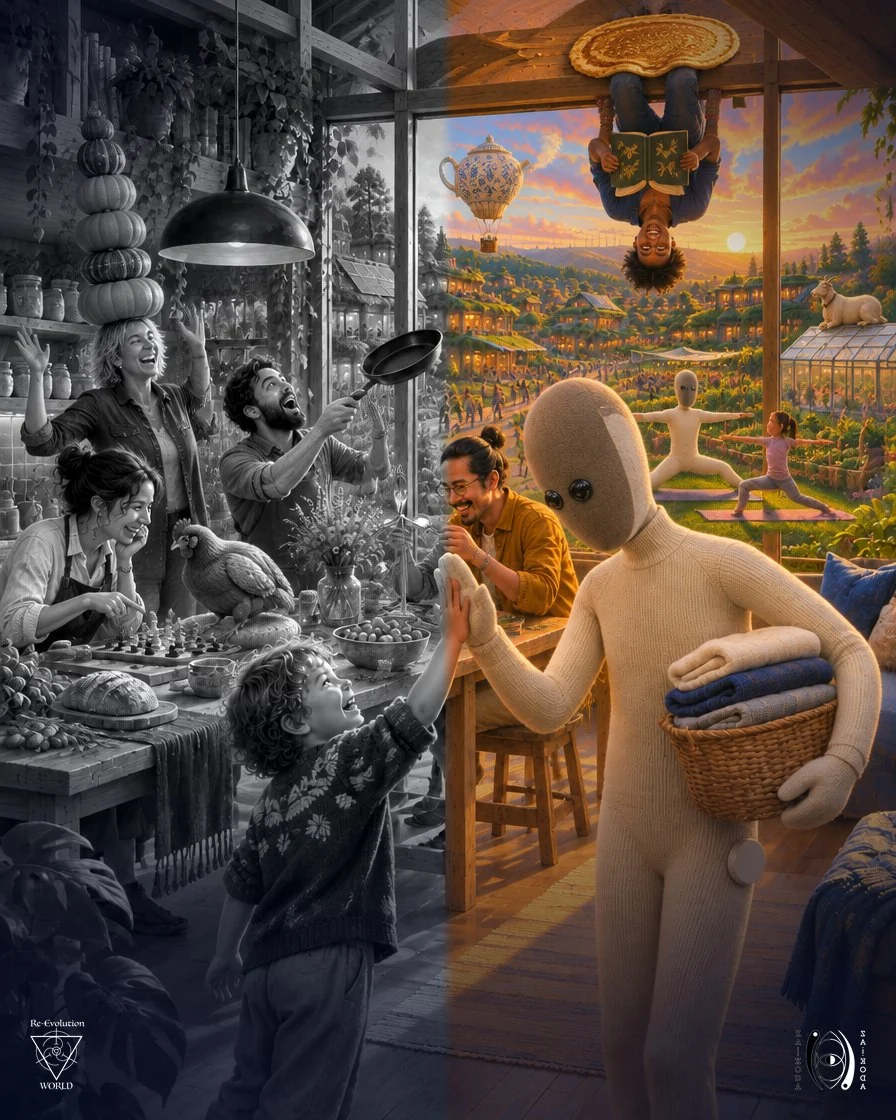
Now imagine these machines built at scale and affordable for everyone, the way phones and solar panels became. A small fleet in every home: one tending the vegetable garden, one at the stove, one working through the endless washing. Somewhere, a rogue pile of unfolded laundry is getting nervous.
Think of who gains first. An elder who can stay in the home they love. A person living with disability who no longer has to wait for help with the basics. A parent with an extra evening a week. The people who spend their days caring for others, finally cared for in return.
A robot that does your washing is a convenience. A community that owns its robots is a revolution. Picture a village co-operative with its own small fleet, owned together and governed transparently on a blockchain, repaired locally, running on its own solar, tending gardens and caring for elders, its gains shared instead of rented back by a distant platform. Machines that carry the repetitive load, owned by the people they serve: that is sovereignty, upgraded. It could free a whole generation for the work only humans can do: raising children, healing land, making art, learning a kung fu form badly and then, one day, beautifully.
We are not there yet. Today's home humanoids are early, costly and still partly human-guided, and the questions of privacy and ownership deserve to be settled now, while the first ones are walking through the door.
So here is a question for you, Sentient: if the chores vanished tomorrow, what would you do with your first free Saturday? Write it down. That answer is the real product.
Re-Evolution: You Are the Solution… 🤖🫶🏽🌏
Sources
- 1. Females do more unpaid work, males do more paid work (How Australians Use Their Time, 2020-21), Australian Bureau of Statistics. Back to top
- 2. Order NEO, 1X Technologies. Back to top
- 3. 1X starts delivering its $20,000 Neo home robot, teleoperator and all, Startup Fortune. Back to top
- 4. Ramping Figure 03 Production, Figure AI. Back to top
- 5. Helix 2.5: Zero-Shot 30-Home Generalization, Figure AI. Back to top
- 6. Unitree R1, Unitree Robotics. Back to top
- 7. Moravec's paradox, Wikipedia. Back to top
- 8. Three reasons robots are about to become way more useful (Melissa Heikkilä, 16 April 2024), MIT Technology Review. Back to top
Want stories like this in your inbox, alongside our gatherings? Subscribe for updates.
Keep reading

Regenerative · For the Planet
The ancestors' way is regreening the desert
In Niger, farmers brought trees back to millions of hectares of bare farmland without planting a single seedling. The forest had been hiding underground all along, waiting for someone to remember how to let it grow.
5 minute read

Abundance · For Freedom
The first human trial to turn back the clock in our cells
For the first time, people have received a therapy designed to turn back the clock inside their own cells. Three patients, eight weeks, one eye each: a small step that opens a very large door. Here is what has actually happened, and what has not.
5 minute read